

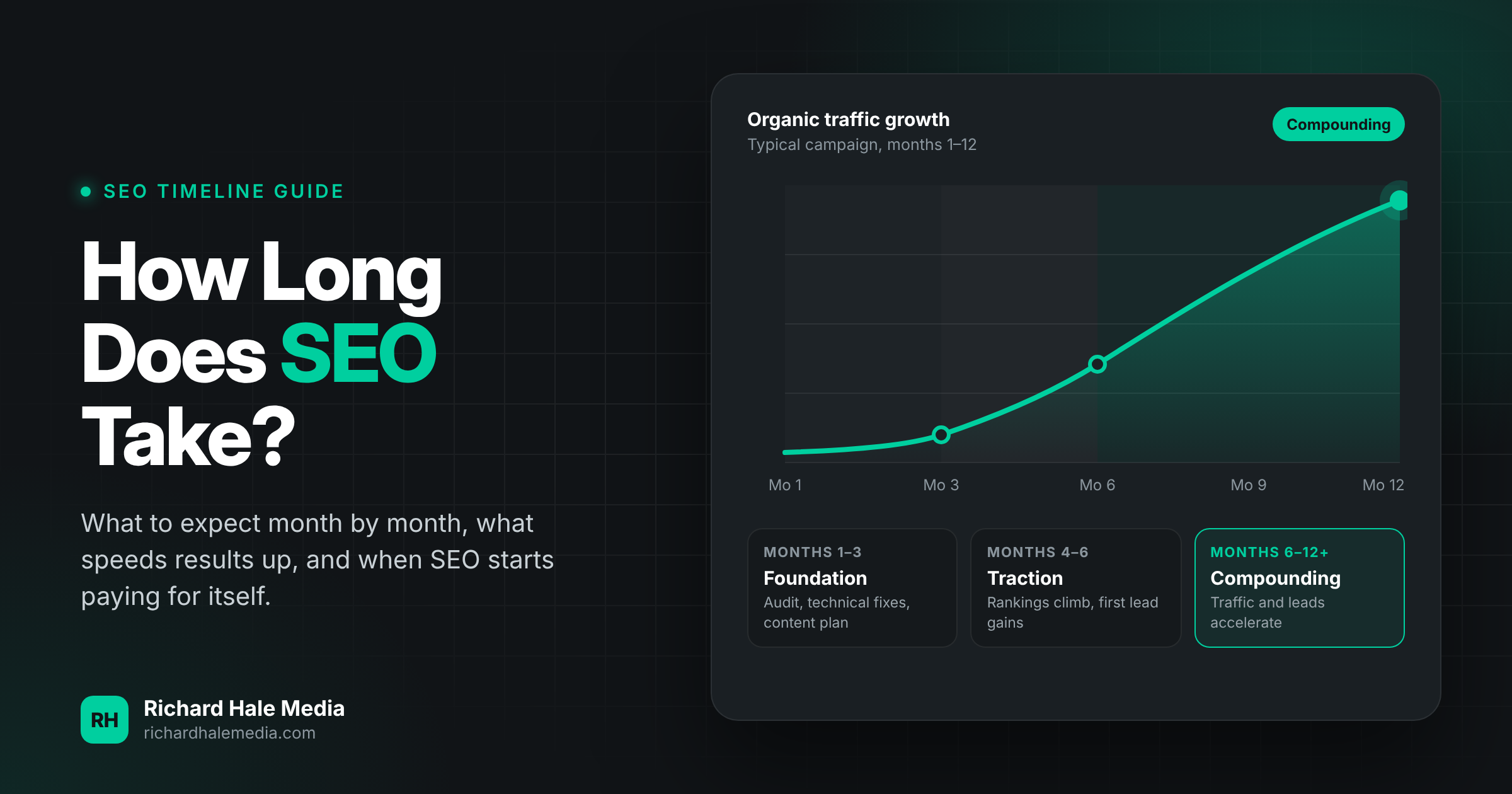
Plan on three to six months to evaluate early SEO traction and six to twelve months to judge whether organic search is bringing in a steadier flow of qualified leads. Those are planning windows. An established website with a fixable indexing issue can see movement sooner. A new business trying to compete across several cities may need longer to build enough visibility in each market. After evaluating over 1K clients over the last 16 years, every SEO case differs, so there’s no universal answer to when you should expect to see SEO growth.
The answer also depends on what you count as a result. A service page can start showing up in Google weeks before it earns regular clicks. It can bring in clicks for months before the business has enough inquiries to tell whether the traffic consistently produces good prospects. If you sell a service with a long sales cycle, the first revenue from those inquiries may come later still. A website with no SEO value to start with will get results slower than a website that has established SEO value. It will always vary on a case by case basis.
Google’s guidance makes a similar distinction at the level of individual website changes. Some updates can be reflected in search results within hours, while others take months. Google generally suggests giving changes a few weeks before evaluating their effect. That guidance covers what happens in search, so your lead and sales milestones need their own review dates. Google Search Central’s SEO Starter Guide
What Counts as an SEO Result?
If your first report says rankings are up, ask which pages moved and what people were searching for. A jump from position 45 to 19 can show that a service page is gaining relevance for a useful query. A move from eighth to fourth on a search with strong buying intent may do more for inquiries. And a page can gain dozens of new keyword rankings without making any meaningful difference to the business.
It helps to separate the milestones so each one tells you something specific.
| Milestone | What you’re looking for | What it helps you decide |
| Discovery and indexing | Google can access and index the priority pages you want people to find. | Whether technical work is still the first priority. |
| Relevant impressions | Those pages appear for searches related to the services and markets you want to grow. | Whether the pages are matching the right demand. |
| Organic clicks | More people visit those pages from relevant unpaid search results. | Whether visibility is turning into visits. |
| Qualified leads | Visitors call, submit an inquiry, or request an estimate that fits your services and service area. | Whether you’re attracting potential customers. |
| Sales and revenue | You can connect inquiries from organic search to booked work or closed deals. | Whether the channel is contributing enough to justify further investment. |
A business that already receives organic inquiries can sometimes improve results at the fourth milestone while rankings hold steady. For instance, a contractor might make its service area clear and repair a broken mobile estimate form. The site is getting the same visits, but more of the right people can reach the business. That’s a different win from climbing the search results, and it deserves to be measured separately.
What to Expect From SEO in the First Year
Use these stages to decide what to check and when. On a large site, existing service pages may be ready for a growth review while newly published pages are still being discovered.
The First 30 Days Establish Your Starting Point
Start with the pages closest to a sale. For a local service company, that might mean its main service pages and the pages covering its strongest markets. For a manufacturer, it may be a handful of capability pages that buyers use to decide whether to send a drawing or request a quote.
When we helped Seniority Healthcare, it took us 6 months to rank home senior care on the 1st page of Google. That’s a 80/100 difficulty level for the keyword. The site had little to no SEO value to start. When we helped Integress rank for aerospace recruiting, it took us less than 3 months – that was because they had some SEO value to start. It varies case-by-case.
Take a baseline for those pages before making changes. Record the searches already bringing people in, the pages they land on, and the number and quality of inquiries that follow. Separate branded searches, such as your company name, from nonbranded searches for the services you sell. A rise in brand searches can be valuable, but it answers a different question from whether new customers are finding you while comparing providers.
This is also when to find problems that can hold up everything else. A page could be missing from navigation, accidentally marked to stay out of search, or redirecting to a generic page after a redesign. Contact forms and phone links deserve a test, too. It’s hard to judge lead growth if the form stops sending inquiries or the business counts every call as a sales opportunity.
By the end of the first month, you should know which changes are live, which pages they affected, and how you’ll judge the outcome. If a priority change is still waiting on a developer or approval, use the date it goes live when assessing its impact.
Months Two and Three Show Whether You’re Targeting the Right Searches
The first encouraging sign may be a small cluster of relevant impressions. A page about commercial sound masking might start appearing for searches about office privacy, ceiling speaker layouts, and sound masking installation. Those terms can reveal whether the page is reaching people who are planning a project or readers who simply want a definition.
Give more weight to movement across a group of related searches than to a single keyword jumping for a few days. If an updated service page starts showing for several ways people describe the same job, you have a stronger reason to continue improving that page. If the impressions come mostly from unrelated searches, revisit the angle before building more pages around it.
Early clicks may also reveal details the page needs. Suppose a remodeling company begins getting visits from people looking for a basement remodel that includes a bathroom. The service page has project photos, but none shows a bathroom addition and the copy never explains what that scope involves. A real project example could help those visitors decide whether the company handles the work they have in mind.
Months Four Through Six Reveal Which Pages Are Earning Attention
At this point, look for a repeatable pattern. Are improved pages bringing in nonbranded traffic in consecutive periods? Is one service producing a disproportionate share of qualified inquiries? Are people finding the new location pages, or is the homepage still carrying nearly all the search visibility?
A six-month review should go beyond sitewide totals. Say organic traffic is up because a guide on deck maintenance is doing well. Meanwhile, the deck replacement page still draws few visits from the towns the business serves. The guide is doing its job, but the business still needs to find out why the replacement page is lagging. It may need clearer local project evidence, better placement within the site, or a different target based on what customers in those towns actually search for.
This is a sensible time to move more effort toward the pages producing qualified inquiries. If one commercial service is outperforming three other priorities, find out why before spreading the budget evenly again. You might have stronger project examples for that service, less competition in the search results, or a much clearer path from the page to a quote.
Months Six Through Twelve Show Whether the Gains Can Hold
A longer review gives you room to see how demand shifts and whether results extend beyond a few high-performing pages. A company may earn new visibility in its home market first, then gain traction on a second service or in an adjacent market as it adds relevant work samples and builds recognition there.
Look beyond lead volume. Which inquiries turned into estimates? Which estimates turned into jobs? Did customers come in for the service featured on the landing page, or did they contact the company about something it rarely takes on? Those answers tell you where to invest next.
Allow for the buying cycle. An urgent home service can get a call and book a job on the same day. A commercial buyer might spend months collecting bids and getting approval. For that business, a small number of requests from qualified buyers can say more about progress than the revenue booked in the same month.
What Makes SEO Take Longer on Some Websites?
Existing Visibility Gives You More to Work With
An established site often has pages already appearing for relevant searches, links from other websites, and a record of which services attract prospects. If a service page sits just outside the first page of results, inspect the gap before starting from scratch. Are competing pages showing relevant work, explaining pricing factors, or answering questions about scope that yours leaves open?
A brand-new website has less history to work with. It needs pages for its core services, an internal structure that makes those pages easy to find, and evidence that the business can do the work. A new site for an established company can draw on existing relationships, reviews, and completed projects. A new site for a new business is building both the website and the company’s visibility at the same time.
Domain age alone gives you little to plan around. A ten-year-old brochure site with a weak service page for each of six offerings may need substantial work. A newer site with a narrow focus, strong project examples, and a recognizable business behind it can have a clearer path for specific searches.
The Competition Changes From One Search to the Next
A phrase that sounds easy in a planning meeting can be hard to rank for once you look at the results. A broad search like “commercial HVAC” might surface large providers, industry resources, and directory pages. A more specific search such as “commercial HVAC maintenance for medical offices” could be a better fit for a provider with real experience in those buildings. It’s worth pursuing when that service has demand and the company can show why its work applies.
Look at who appears repeatedly for the searches you care about. Review the kinds of pages that appear, how well they answer the query, and what a buyer would learn from them. A product category, a comparison guide, and a local service page serve different purposes. If most results are service pages and you’re trying to compete with a broad educational article, rewriting a title is unlikely to resolve the mismatch.
Useful Details Take Time to Gather
A service page gets more useful when it answers the questions a buyer would otherwise have to call and ask. What’s included in the work? Which properties or projects are a fit? What changes the price? What happens between the first conversation and the start of the job?
Getting those details often takes longer than writing the page. A manufacturer may need input from an engineer to explain material limits or how it evaluates part drawings. A remodeling company may need permission to use photos and enough information to describe what changed between the original plan and the finished project. That effort gives the page substance that a generic rewrite can’t supply.
Publishing more frequently can help when you have clear gaps and enough expertise to cover them well. It can also spread your effort thin. If the service you want to sell is buried in a single paragraph on the homepage, give it a proper page before commissioning a dozen articles about related topics.
Technical Problems Can Delay Work You’ve Already Done
Search engines have to discover and process a page before it can appear in results. If a priority page is hard to find through internal links, unavailable to crawlers, or telling Google to treat another URL as the preferred version, content improvements may have little opportunity to show an effect. Google says that recrawling can take days to weeks, and a request to recrawl does not guarantee inclusion in search results. Google’s guidance on recrawling
The impact depends on the scope of the fix. Correcting one broken internal link is different from cleaning up thousands of duplicate product URLs. On a site move, map each important old URL to its closest new equivalent and update internal links. Google says that even on a small or midsize site, processing a URL move can take a few weeks for most pages, and search visibility may fluctuate during that period. Google’s guidance on site moves
Implementation Determines When the Work Can Start Paying Off
Two businesses can buy the same number of months of SEO and end up with very different amounts of work live. One approves a revised service page in a week. The other has three teams reviewing it and publishes two months later. At their next review, the first business has several weeks of search data and the second may have none.
During planning, settle who can approve copy, make website changes, and supply project photos or technical details. If an important change has to wait, put work that can go live sooner on a separate track. A contractor waiting for a website rebuild can still complete a business profile, document recent jobs, and fix contact information on the current site.
Budget has a similar effect. More resources can shorten the time it takes to research, fix, write, and publish. They can also support parallel work on technical issues and priority pages. The time Google takes to process those changes, and the time prospects take to buy, still need to be reflected in the forecast.
How the SEO Timeline Changes by Business and Website
Local SEO for a Service Business
For a business with an established presence in one city, the quickest opportunities may be close to home. Picture a kitchen remodeler with years of completed projects and a Google Business Profile that still describes it mainly as a general contractor. Its kitchen remodeling page is thin and the strongest photos are tucked away in a gallery without project details.
The starting work is straightforward. Update the profile with accurate information, build out the service page, and explain what the team has done in the area. One project could show how the crew opened a closed kitchen without losing storage. Another might explain why moving a sink added plumbing work and changed the schedule. Those details help someone in the middle of comparing local remodelers.
Measure Google Maps and website search results separately. Google says local results primarily depend on relevance, distance, and prominence. A business can become more visible to people near its location and see a different pattern in the suburbs. A search from the owner’s office provides one view of the market. Google’s local ranking guidance
SEO for a New Website
A new specialty manufacturer might start with four service pages covering metal stamping, wire forming, finishing, and machining. An early goal is to show up for buyers looking for a specific capability. A page about copper stamping can explain suitable applications, project variables, and what information to send with a quote request. It gives both buyers and search engines a clearer idea of what the business offers than a page listing every manufacturing service in a few sentences.
Expect some pages to gain traction before others. A specialized capability with fewer strong competitors may start getting relevant impressions while broader service pages are still quiet. Use that feedback to decide which page needs more depth, which adjacent service deserves a page of its own, and where a case study would answer a buyer’s next question.
A first inquiry can come through early on a low-volume search. Treat it as evidence that the route works for at least one buyer. Look for a pattern over a longer period before forecasting how many leads that route can generate.
SEO for an Online Store
An online store with hundreds of products may get more out of improving its core category pages than rewriting product descriptions one at a time. Shoppers often begin with a category and narrow by size, material, fit, or use. A useful category page helps them compare the range, gives them a reliable path to in-stock products, and answers the questions that affect their choice.
Inventory complicates the timeline. A collection can gain rankings while its bestselling sizes are sold out, leaving clicks up and sales flat. A retailer that removes seasonal categories after each season also makes it harder to build on the same pages next year. Judge progress at the category level and keep stock, price changes, and promotions alongside the search data when interpreting revenue.
SEO Recovery After a Redesign
We have a framework, a SOP that we follow anytime we redesign a new website. It ensures we keep as much SEO value possible during the new web development build. The technical SEO is important. Maintaining featured snippets and all keyword rankings are priority, but a lot of business owners see massive SEO losses when they switch to a new design.
A sudden drop after a redesign calls for a different timeline. Find the pages that lost the most relevant traffic and check where the old URLs lead. If every retired service page redirects to the homepage, a visitor following an old search result may end up several clicks away from the service they wanted. The same change can also make it harder for Google to match the old page to its new equivalent.
Start by restoring those paths. Then check whether essential page copy, internal links, and location information survived the redesign. Compare the affected pages with similar pages that kept their traffic. A fix can begin showing results as Google processes it, but a redesign that changed URLs, removed content, and rewrote the navigation creates several issues to work through. Log when each fix goes live so you can see what happens on the pages it affects.
How to Tell Whether SEO Is Working Before Leads Pick Up
Judge Pages and Searches in Groups
Track related pages together. A home services company might have one group for repair, one for installation, and another for maintenance plans. Compare each group with its own baseline. If repair pages are moving and installation pages are flat, the business has a much more useful starting point than “organic traffic rose five percent.”
Look at the mix of searches behind each group. Average ranking can slip when a page begins to appear for a wider set of new queries at lower positions. Meanwhile, it may be moving up for the specific searches most likely to bring customers. Check those searches and the pages that appear for them before acting on a sitewide average.
Compare similar periods. A 28-day review can reduce the effect of one unusually good or bad week. For a seasonal business, compare the same part of the previous year when data is available. An air conditioning company may get fewer clicks in a cool spring even if its position holds. Google recommends checking longer date ranges and comparable periods when investigating search traffic changes. Google’s guide to diagnosing search traffic drops
Follow the Inquiry Through to the Sale
A click tells you someone reached the site. To find out whether SEO is helping the business, follow the inquiry a little further. Record which service the person asked about, whether the job is in the service area, and whether it moved to an estimate or sale. A dozen inquiries for work you decline can look like a strong month until you review the actual conversations.
Some leads start in search and return another way. A buyer might find a commercial service page on Monday, share it with a colleague, and come back directly on Friday to call. When the source is known, keep it with the inquiry. A brief “How did you find us?” during intake can provide context, especially when several people are involved in the purchase.
What to Check When SEO Progress Stalls
If Important Pages Have Few or No Impressions
First, confirm that the pages are indexed and that Google is showing the URLs you intended. If a service page competes with an old version, check which one is linked from the main navigation and whether both are still accessible. If the right page is indexed, consider demand and intent. A page called “Integrated Workplace Solutions” might describe work customers search for as “conference room AV installation.” The service can stay the same while the wording becomes easier for customers to recognize.
If Impressions Are Up but Clicks Are Flat
Find out which searches account for the extra exposure. If most of the new impressions come from low positions, the page may still be earning its way into a part of the results where people see it. If the page is already competitive on relevant searches, review its title and how it appears alongside other results. A page title that names the specific service and market can set a clearer expectation than a vague promise of quality. Check whether directories, Maps listings, or other prominent results are also competing for attention.
If Clicks Are Up but Inquiries Are Flat
Open the landing page on a phone and try to contact the business as a customer would. Look for the phone number, coverage area, and evidence that the company takes on the job described in the search. Submit the form and confirm where the inquiry goes. Then compare the searches that brought people in with the kind of work the business wants. A guide that attracts people looking for a DIY repair can perform well in search while generating very few calls for a paid repair service.
If Inquiries Are Up but Sales Are Flat
Review the inquiries with the person who handles them. See how many were a fit, how quickly they received a response, and where qualified prospects dropped out. If callers keep asking for projects below the company’s minimum scope, make that scope clearer on the service page. If well-qualified prospects are getting estimates but haven’t made decisions, give the sales cycle time to run before judging the month by closed revenue.
How to Get SEO Results Sooner
The shortest path usually starts with one of two things. Fix a barrier keeping an important page out of search, or improve a page already earning attention for a service people buy. Both give you something concrete to check once the work goes live.
- Start with pages near a decision. Prioritize services and locations that have search demand, a clear offer, and enough business capacity to handle more inquiries.
- Improve the pages that already have traction. Add the project details, scope, or pricing factors that help a buyer make a decision. Keep the existing URL when it still fits the page.
- Give useful pages a place in the site. Link to important services from related project pages and guides where a reader would naturally want to learn more.
- Pursue links that customers could realistically follow. A supplier directory, a trade association, or a project partner may have a legitimate reason to reference your business or a piece of work you did together.
- Put a review date on important changes. Once you’ve published the work, give it time to gather data. Rewriting the same page every week makes it harder to tell which change helped.
At Richard Hale Media, founder Richard Hale brings 16 years of SEO experience to a question every business should ask before investing in search. Which pages are closest to bringing in the customers you want? If you’re planning an SEO campaign, start with the services you want to grow, the markets you can serve well, and what a qualified inquiry looks like. That gives us a concrete starting point for setting your first milestones. Richard Hale Media
Frequently Asked Questions About How Long SEO Takes
How long does SEO take to show results?
Allow three to six months to evaluate whether priority pages are gaining relevant visibility and organic clicks. Six to twelve months gives many businesses a better window for judging whether those gains generate qualified leads consistently. Some individual changes can show an effect sooner, especially on pages that already rank and get traffic.
Can SEO work in 30 days?
Yes, especially when you fix a specific problem on an established site. Restoring a broken service URL or removing an accidental indexing restriction can produce early movement once Google processes the change. Use the first 30 days to get important fixes live, set a baseline, and see whether priority pages are moving in the right direction.
How long does SEO take for a new website?
Give a new site several months to assess visibility for specific, relevant searches. Use six to twelve months as a planning window for evaluating sustained performance, particularly if the business and its online presence are both new. A narrow service with clear demand may gain traction sooner than a broad site going after competitive terms across several markets.
How long does local SEO take to work?
Use the first few months to assess whether an established business is gaining visibility for searches close to its location. The timetable can extend in crowded markets or when the goal is to reach several distinct areas. Review Maps visibility and website inquiries by market, since proximity and local competition can produce very different results from one neighborhood to the next.
How long does it take to rank on the first page of Google?
The timeline depends on the search and the page’s starting position. A page already close to the first page for a specific service may move after a few well-targeted improvements. A new page targeting a broad, competitive term may take many months and may still fall short. Group your targets by intent and business value so you can see whether the rankings you’re gaining are worth the effort.
How long does it take Google to index a new page?
Google says crawling can take anywhere from a few days to a few weeks. Indexing is a separate step. A page can be crawled before it is indexed, and once indexed, it may take longer to appear for the searches you care about. Give the page a clear path from other relevant pages on the site. Google’s guidance on crawling new and updated pages
How long does SEO take to generate leads?
A site with existing search traffic can generate inquiries quickly after improving a service page or fixing a contact problem. If the business needs to build search visibility first, give it several months to earn relevant traffic, then allow time to see whether those visitors become prospects. For a low-volume B2B service, review qualified inquiries and quote requests alongside closed sales.
Does SEO need to be done every month?
The work changes as the site matures. A stable local business may need periodic reviews and updates when it adds services, completes a significant project, or sees a change in demand. A growing store or a company entering new markets may have worthwhile work every month. The right cadence depends on how much is changing and where additional effort can support the business.